
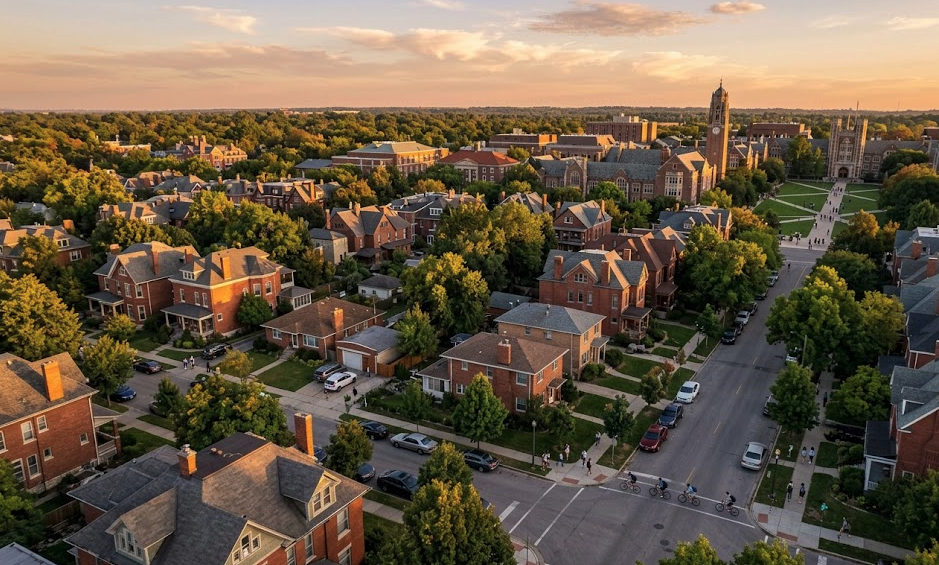
When Las Vegas home prices collapsed 63.9% between 2007 and 2012, certain markets barely flinched. Ann Arbor, Michigan — home to the University of Michigan — held its value with an almost unsettling calm while the rest of the country bled equity. It wasn't luck. It was enrollment.
The relationship between major research universities and local residential real estate is one of the more durable patterns in American economic geography, yet it remains systematically underappreciated outside academic circles. For scholars, administrators, and institutional researchers who spend their careers inside these ecosystems, the housing market next door is often an afterthought. That's a significant blind spot — particularly as higher education enters its own period of structural disruption.
The Demand Floor That Doesn't Move
What makes a university-adjacent housing market different from a conventional one comes down to demand composition. In a typical mid-size city, residential demand rises and falls with corporate employment cycles. A major employer closes a facility; the housing market softens. A hiring wave hits; prices climb. The feedback loop is tight.
University towns break this loop. Graduate students need housing regardless of mortgage rate cycles. Assistant professors must live within commuting distance of their labs. Hospital staff attached to academic medical centers — a category that includes entire urban neighborhoods in cities like Albuquerque, where UNM Hospital is the state's only Level I Trauma Center — generate housing demand that is structurally independent of interest rate policy.
This is the demand floor concept: a baseline of occupancy that doesn't disappear during recessions because the institutional anchor doesn't downsize the way a private employer does. During the 2008-2012 housing crash, peak-to-trough declines in Las Vegas, Phoenix, and Miami exceeded 50%. In markets anchored by major universities and research hospitals, the story was qualitatively different.
The Research Multiplier
Enrollment numbers are only part of the equation. The more powerful economic driver — and the one least understood outside higher education — is research funding.
UNM's consolidated budget for fiscal year 2026 stands at $4.615 billion. That figure isn't tuition revenue. It includes federal research grants, contracts, and the full economic footprint of an R1 research institution embedded in a city of roughly 560,000 people. In 2024, UNM's Health Sciences Center alone drew $161 million in research grants while contributing $1.6 billion to the regional economy. The university saw 900,000 total patient visits that year.
This research multiplier matters for housing because it creates a class of relatively high-income, immobile residents. A postdoctoral researcher on a three-year NIH grant isn't leaving the city mid-lease. A tenured faculty member in the medical school doesn't relocate when the S&P corrects. Their housing demand is sticky in ways that corporate employment isn't.
Compare this to what happened in Austin between 2022 and 2023. Despite anchoring UT Austin — one of the country's largest public research universities — Austin's housing market fell 10.02% in that period, the steepest decline among the nation's 400 largest markets. Moody's Analytics had assessed Austin home prices as overvalued by 63.7% at the peak in Q1 2022. The lesson isn't that universities provide immunity. It's that universities provide a floor — and bubbles can still form above that floor when speculative demand overwhelms institutional demand.
What Enrollment Trends Tell You That Transaction Data Won't
Here's something the real estate data aggregators miss: enrollment trends are a leading indicator for neighborhood-level housing demand, typically running 18-24 months ahead of any visible price movement.
UNM's fall 2025 enrollment reached 23,955 at the Albuquerque campus — the fourth consecutive year of growth, and the sixth consecutive year of growth in first-year registrations. The incoming class of 3,814 students was the largest in the university's 136-year history. International student enrollment jumped 57.9% in a single year's incoming cohort as of fall 2024.
For anyone tracking residential markets near the UNM campus, those numbers describe a structural increase in housing demand concentrated in a geographically specific area. Neighborhoods within walking or biking distance of a major university don't expand their inventory quickly. Zoning, established residential character, and limited vacant land constrain supply. Growing enrollment therefore translates — with a lag — into upward price pressure and declining vacancy rates in a well-defined catchment zone.
Those researching or relocating to Albuquerque for academic positions frequently start with neighborhood-specific IDX searches; platforms like Albuquerque Homes Online's UNM area listings reflect exactly the kind of geographically bounded inventory that tracks this demand pattern.
The Institutional Stability Premium
Academic economists have a name for what happens to asset values in close proximity to stable, growing institutions: an institutional stability premium. It shows up in cap rates, in price-to-rent ratios, and in the speed with which inventory turns even when broader market volume is declining.
The mechanism is partly psychological and partly structural. On the structural side, universities create a density of amenity-seekers — coffee shops, bookstores, health food markets, cycling infrastructure — that independently raises neighborhood desirability. On the psychological side, a major research university signals permanence. It will not be acquired, relocated, or shut down in a leveraged buyout. That certainty is worth something in the pricing of a long-duration asset like a house.
Ann Arbor's housing market has appreciated at roughly 7.8% annually since 2020, according to investment analysis tracking elite college town markets. That's in a city where the University of Michigan's research budget exceeds $1.5 billion annually. The correlation isn't coincidental.
The Caveat That Actually Matters
The university-town resilience thesis has one important qualifier: institutional anchor and speculative bubble are not mutually exclusive. The same dynamic that creates a demand floor can become the justification for a supply shortage narrative that inflates prices beyond what fundamentals support.
The honest version of this analysis acknowledges that proximity to a research university improves downside protection — it doesn't eliminate market risk. Investors who treated Austin's UT affiliation as permanent price support in 2021 discovered this the hard way. The floor held; the ceiling they'd assumed had no basis.
For graduate students, early-career faculty, and academic administrators evaluating housing decisions near established research universities, the relevant question isn't whether university proximity is a positive factor. It almost certainly is. The relevant question is whether current pricing already reflects that premium — and by how much it might be overreflected.
That analysis requires local inventory data, neighborhood-level price history, and proximity mapping that goes beyond any national aggregator. It's work worth doing before making a decision that will likely outlast any single academic appointment.